Showing posts with label Childhood. Show all posts

Tuesday, 7 August 2012

Protecting children from radiation - lessons from Fukushima

Managing long-term risk and minimising children's exposure to radiation

Please note: I am not an expert - this informally covers some of the ideas being shared by families living in Fukushima at the time of the disaster for your information. I have written it as I could not find anything similar when I really needed it. It does not cover the first days of a nuclear emergency. It is written from the point of view of minimising risk to be on the safe side, not an from an assumption that we can know definitely either way what that risk is in the current scientific climate.

We, like most families who were, or are living in Fukushima, have been trying to understand how to minimise the risk for our children. Contamination is something children in affected areas of Japan will have to live with throughout their development, and we may not know the consequences until 20 or 30 years later.

There is agreement that unborn foetuses, children and young people and especially females are more at risk. However there is no scientific consensus on long-term risk from accumulations of low doses and there are acknowledged holes in research and knowledge. The nuclear industry, government, regulatory bodies and their tame 'experts' and advisers have displayed blatant collusion and dishonesty, destroying trust. Research is expensive and there are big gaps in our knowledge in consequence. Guidance and planning is very patchy, including some glaring omissions and irresponsibly risky assumptions motivated by minimising compensation and clean-up costs. There have been examples of false reporting of levels in soil and food, the false labelling of food from contaminated  areas as being from safe areas, and the mixing of  food with high levels with food with low levels to produce a batch with overall 'acceptable' levels.

As parents we have to make own judgements and if concerned it makes sense to try and minimise our children's lifetime exposure, just as we think carefully about risk from crossing the road, unhealthy diet, or passive smoking. For your information, here are some of the solutions that parents in Fukushima and beyond are sharing with eachother:

Food and drink

  • Avoid giving children food or drink from any contaminated region with a wide margin of safety.
  • Some foods are particularly susceptible to contamination (bio-availability). Wild food, especially mushrooms, berries and vegetables gathered in the mountains have been found with especially high levels and are best avoided. As at August 2012 the highest officially tested level was wild mushrooms picked in Nikko City area, Tochigi Prefecture, at 31,000bq/kg - the official 'safe' limit is currently 100bq/kg. The previous record was wild mushrooms from Fukushima at 28,000bq/kg
  • Check the origin of everything before buying. With products with mixed ingredients where the origin is not marked this means contacting the company concerned. Ask them where their factories are and if the factories have handled produce from contaminated areas. Do they check their production themselves? If they won't tell you, don't buy from them. The same applies to eating out - contact the company and ask where they source their products. If they won't tell you, don't eat there. Many families in Japan now do this.
  • Campaign for school meals and milk to be sourced from safer areas. Until they are insist on your child eating a lunch brought from home - some schools may be resistant to this. Be aware that some schools may check the ingredients, but the minimum detection level of the equipment is too high, for example 20Bq/kg - below this may give as a false zero. Even away from contaminated areas this is an issue - for example, Fukushima rice was provided in an Okinawa school.

Checking levels and gathering information

  • Buy a dosimeter / Geiger counter, ensuring that it can detect various kinds of radiation, and learn how to use it properly. This is necessary because the government will never test everywhere, and hotspots have been found by individuals. Check inside and outside your house. Typical areas of higher radiation are drains and water-courses, where rain falls from roofs, and in gardens where contamination can be blown or washed in from surrounding areas in the form of dust, leaves or other organic material.
  • Note that levels can increase over time in some locations due to the interaction of weather, landscape, and biological processes. Therefore re-testing will be necessary for the foreseeable future. Areas that have been decontaminated can become re-contaminated.
  • Regularly check official information- but informally shared information and information from abroad is also vital - in the Japanese situation the latter two have often been more reliable. For example radiation prediction weather maps from Germany and later Switzerland were invaluable and information shared between citizens via Twitter and Facebook. 
  • Think for yourself, don't assume that the attitudes displayed around you are the right ones for your family (or are even what people are thinking privately). Only you can decide what is right for your children.

Location, housing and play

  • If possible move your children away permanently to a less contaminated area. This the number one and only sure solution. Careers, family tradition and owning property are important - but if our children get sick we suddenly realise that our children's health comes first.
  • If you can't move away yet, take children away at weekends and holidays. Research possible resources and help for moving away in case it becomes possible to move.
  • Check the weather forecast - if the wind is blowing from the accident site don't let them play outside. While air radiation levels are high, keep children inside, especially  when it is raining.
  • Check air and soil levels anywhere your children spend significant time, especially at school and routes to school. Insist that schools are decontaminated, or if possible change school.
  • Note that decontamination has had limited temporary results, with levels rising again. It is not a long term answer and can be dangerous for those doing it, often by hand - and where does the material go?
  • Minimise the chance of children inhaling radioactive particles in dust. Don't allow them to play in  dusty areas. Get them to wear a suitable mask if they are inevitably exposed to dust.
  • Inform children how to protect themselves - thinking about where to avoid (eg drains, ditches and under roof edges), washing routines when coming inside and changing clothes for inside.

X-rays and medical treatment

  • Avoid unnecessary x-rays. Some parents are asking that only essential x-rays are done, although this will be a matter of discussion with the doctor or dentist concerned. Japan has one of the highest uses of medical x-rays in the world, and sometimes they are done as a matter of routine or habit even before a physical examination has suggested that one is needed. Clearly there are cases when x-rays are essential and the benefits outweigh other concerns.
  • A Japanese doctor has written a letter intended for those treated abroad to give to their medical practitioner - however it contains a useful summary of the medical situation of Japanese children exposed to radiation from Fukushima Daichi. This will give you a sense of the subject should your own family be at risk.  Click here.
This list is not definitive and arguments can be made for and against each point, however I hope reading what Japanese families are doing helps you with your thinking should you be unfortunate enough to have to deal with this problem, or feel you should prepare just in case if you live down-wind from a nuclear facility.
   

    Thursday, 18 August 2011

    Fukushima children's art project

    9 year old Fukushima child's anger and sadness at Fukushima Daiichi


    I'm sorry I haven't been able to post anything for quite some time. I have given most of my spare time to my new project Strong Children, and our house has just been flooded out by the Tadami river for goodness sake! Life was obviously getting too simple here in Fukushima. 

    Strong Children consists of portraits of Japanese children and young people living with the ongoing consequences of the Fukushima Daichi nuclear accident, the Tohoku earthquake and tsunami of March 11th 2011. Please take a look. The images are designed and made by the children, with words too if they wish. I add their portrait according to their instructions - they choose the pose, facial expression, colour and feeling. The aim is to enable them to share their important experiences and thoughts with the world at this crucial time. It is a collaboration, but they are the boss.

    In my view children need an appropriate setting that gives them permission and safety to express a whole range of emotions and thoughts. That includes fear, sadness, grief and anger sometimes, as well as happiness and the more socially acceptable cute and joyful aspects of childhood. 

    I also want to create a channel for them to reach the world and get feedback, and to affect the policies that shape and limit their living conditions, health and happiness. This completes a positive circle they can feel proud of and empowered by. Finally, no record of important historical events, or thinking about energy choices or ethics for that matter, can be complete without including children - even if it is just seeing the marks they make, and looking into their eyes as they gaze from a portrait.

    If you would like to support or help exhibit, publish or disseminate the project, please contact me

    Thursday, 17 February 2011

    Snow festival giant

    Every house should have one: our 2.5 metre snow giant

    It's Nakagawa snow festival at the weekend, and having missed the more famous Tadami snow festival once again through being in Tokyo, I decided to get with the programme and do something with the snow other than shovelling it away from the entrance. I shovelled it back towards the entrance.

    There's a bit of a "Roy Wood and Hagrid meet that guy with the octopus beard in Pirates of the Caribean at Karl Marx's gravestone" kinda thing going on here don'tcha think?


    Tadami festival apparently had a Taj Mahal with arches and arcades you could walk under made by the army, sorry, Ground Self Defence Force. My son and I decided to make do with a more modest one for our first go, though you can sit on it if you are under 10. He was a big help with gathering the snow, although much of it arrived in the form of big chunks tossed in the direction of my head - entirely accidental I'm sure. He made the hands and feet though, before reverting to the aerial bombardment. Where are the GSDF when you need them?

    Monday, 31 January 2011

    Child throwing in the snow

    Snow-blowing the pavements and delivering the newspapers

    The snow has been falling constantly for many days now, reaching intimidating 'end of the world' quantities - and what if it never stops? It is forecast for the next week too. Snow is piled up to the first stories now, and becoming too heavy for many roofs, so everywhere there are old people risking life and limb cutting big slabs from high up on their roofs. I'd like to help, but I know from past experience that an offer of help can be taken as doubting the ability to cope and an insult to proud and very capable people, however old they are. In fact the lady at the shop said it is shovelling snow through the winter that gives Aizu people their tough spirit. She is probably right.


    There is a 2 metre hat of snow on everything, in this case a rice husking kiosk


    So what would it be like trying to get about without the huge effort and resources put into clearing it? Having tested it today in what used to be the garden I can report that walking through a patch of virgin snow is....well, interesting. You sink into deep powder up to the crotch, which makes for hard work. Walking is possible, but not probable. Even snow shoes don't keep you on top of this stuff - I tried and sank in 30cm, which is still hard work.  If you were properly snowed in, you had better have a full season's worth of provisions. This probably explains Aizu people's love of all things dried and pickled and their cheerful 'We're all in this together' attitude.

    How many times have I got to tell you? Not the face!

    I have also conducted child throwing experiments. If you throw a medium-sized child into the air they sink a couple feet down into the very soft snow, which is satisfying both for child and thrower. These results may not be reproducible, and even then, as Hume pointed out during a particularly white Scottish Christmas, "There is no reason to suppose that the causal link we perceive between throwing the child and it sinking into the snow will always occur in the future." Perhaps tomorrow he will float off into the sky, then boy won't I be embarrassed about my reliance on instinctive inductive inferences.  

    My son and I make inroads into the piled snow with our daily snowball fights. Ordinarily useless at ball games, my aim is getting better which should help in the unlikely event that I choose to add baseball onto my list of Japan-specific activities. The snow might have been specially engineered for snowballing perfection (no Dawkins, I don't mean it literally) - to grasp it is to have a sticky wodge ideal for chucking in quick-fire succession. It's just as cold down your neck and in your ear though. However, I have concluded that snowballing is about as efficient at re-distributing snow as the 'trickle down' theory is at wealth re-distribution. You still end up with a big pile in the same place.

    Wednesday, 17 November 2010

    Children's art

    From the great kids around the village...


    Sunday, 18 July 2010

    Kabutomushi kids

    A kabutomushi or Japanese Rhinoceros beetle

    No Japanese childhood is complete without bugging bugs, inspecting insects and pestering pests. Kings of the crop and prized captives for all the mini marauders in the area are Kabutomushi, Japanese Rhinoceros Beetles. Along with Japanese stag beetles, these are objects of great desire for local boys, and for girls too, no squeamishness there. The school even provides them - or at least acts as a conduit, though who provides them I'm not sure. Playtime might see a clutch of kids surrounding a joisting tournament to determine whose beetle is the strongest, using their instinct to push away rivals Sumo style for mating grounds and food.

    These beetles are strong, big, and they fly. My son was wary of touching insects last year, especially being used to puny English bugs. I used to annoy pond life* as a boy in Lancashire, and we were very proud if we found a Great Diving Beetle, which are only the size of the first joint of your thumb. Rhinoceros beetles would have blown our tiny minds, although the Great Diving Beetle admittedly has habits more satisfyingly nightmarish to the boyish mind.

    My son gained his badge of courage and has now learned to handle them confidently. This was somewhat shaken this week when the beetle he was holding by the point on it's shell managed to latch onto his hand and crawl up his arm. You should know that they have sharp claws and they clamber around by sticking them into any available surface like an ice climber whacking axes into an ice cliff. In this case the surface was my son's skin, leaving a trail of red pin pricks up his arm. This softened him to our insistence that we only kept the two he brought home form school for a week, so they could go off and do their romancing and wild living in the woods. 

    Most kids keep them in plastic tanks for months, and they spend half their time trying to get out. That would be my plan too. We spent an hour in the garden today  crushing and drowning the small beetles that were daring to eat our potatoes, then came over all squeamish and protective about the beetles in the tank. No inconsistency there then. Vegetarianism seems to involve rather a lot of killing as it turns out.
    My son doesn't have a lot of luck with Kabutomushi - this one fell out of a tree onto his arm last year. It hurt.
    We took the reprieved prisoners up to the playground at the shrine this afternoon. The big one knew exactly what to do with his freedom and escaped through the holes in our logic. He was axing up the big tree at speed in no time, higher and higher until it fell off from a dizzy height, apparently by accident and took wing instinctively, sailing off into its luvin' future through the tree tops,  humming a Barry White song. The other fell off after three inches onto it's back, heaved itself half-heartedly up the tree a few feet, then crammed itself into a crack and hid. I don't know, you do your best, but they just have their own personalities right from the start don't they? You just have to let them go in the end though, the little darlings, don't you?

    *Now I am pond life

    **********************************

    Tuesday, 13 July 2010

    McChildhood and the real McCoy

    What happened when we asked local children where they would like to live when they grow up.

    The hydro-electric dams across the valley were unexpectedly popular


    At a recent after school club session we decided to ask the children (aged 7 to 9) to think about where they thought they might like to live when they grew up - here in Kaneyamamachi, in a nearby town or city like Wakamatsu, or in Tokyo. It is important that children are involved in thinking about this, as by the time they reach adulthood the exodus from the countryside will effect them more than anyone. We used a decision line method, with two opposing options at each end - the children were asked to stand where they would like to live. They then gave their reasons for standing where they did, and afterwards made drawings of what they liked about where they chose.  The session was enlivened by the presence of a film crew from TV Asahi, who were filming us as part of the travelogue series 'Beautiful Japan.'

    No surprise that the school's outdoor swimming all summer is popular

    Nearly half of them chose to go to the Tokyo end of the decision line, with three in the middle opting for the nearer towns, and nearly half standing at the Kaneyamamachi end of the line, predicting that they would stay here.

    It was interesting that the Tokyo group couldn't immediately think why they had chosen to be there. With some prompting, they came up with shopping, Disneyland, and in the case of my son, Sunshine 60, a huge building with a panoramic viewing floor. They could think of what they might play with or eat, but they didn't really know what work they might do. When it came to making drawings of what they liked about the city they were really nonplussed, and sat blankly staring at white paper while the group who wanted to stay here launched exuberantly into their drawings. In the end some of what they drew could equally be experienced here -  a hamburger, some dogs, fashionable clothes. One drew the Tokyo Disneyland Hotel, another a skyscraper. 

    McChildhood comes to Japan: dumming down one of the healthiest diets in the world

    It felt a little as if they were the puppets of television advertisers, with invented needs that could vaguely somehow be met by Tokyo, or perhaps were simply wanting what they felt they couldn't normally have living in the mountains. The most articulate little mite, all of seven years old and tiny, drew a big blue question mark:

    He said that he knew that he didn't really know what Tokyo was like, but that was why he wanted to live there - to find out. An amazing thought for his age.

    The group who wanted to stay in this area new exactly why they liked it. Swimming! Skiing! My family! The dams! The food! Stag beetles! And in the discussion they launched enthusiastically into defending Kaneyamamachi. My favourite drawing was of the child's house (with a yellow roof) connected to all the other houses in their village by paths, which seemed to express perfectly the closeness of the community and the warmth of feeling for children.

    The village- wide web

    It was rewarding and thought provoking to see one of Japan's major issues, the continued centralisation of life in two big cities and the emptying of the countryside, played out in the imaginations of children. Before long it will be a choice they will face for real, and one that may be determined by the practical necessities of work and money rather than personal preference. In the meantime I hope they can have a say in what happens, while enjoying what must be one of the best places anywhere to grow up. Childhood's real McCoy, beautiful, innocent and healthy in mind and body.

    ***************************

    Thursday, 24 June 2010

    One wheel on my wagon


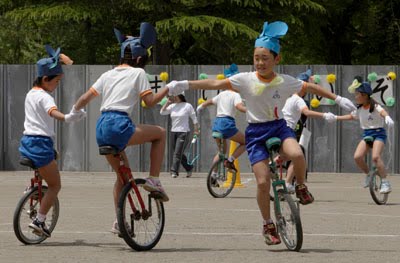
    One of the most touching and improbable moments of my first year in Kanyamamachi was the moment when groups of children drifted out of the shadows of the sports hall and across the baking grit of the playground. Improbably and delightfully they were all holding hands and riding unicycles. The ancient dark of the woods loomed behind, crowned with the hidden earthworks that are all that is left of the harder times when a castle was needed. The contrast  with the dreamlike moments of happiness sparkling under a cloudless sky was perfect. Wheeling and turning in patterns, the children smiled as their parents clapped. It is the miraculous high point of the school sports day each year.

    In the year since that day my son has learned and proudly invited us to a private showing. I was duly proud in return, especially when I had tried it and found out just how hard it is.

    The school is split into two halves for sports day, the red team and the white team, which then engage in day-long gladiatorial combat spread across more than twenty events. This year one of them was another innovation designed to inculcate the smooth if competitive team working that is central to Japanese culture. It involved a kind of hyped-up leapfrog, with each member having to jump their team-mates in turn. The loosing white team's last boy began running over the backs in a desperate attempt to keep up, producing a beautiful leap as a final, if loosing, flourish.


    ***************************

    Friday, 12 March 2010

    Bubblegum carnage

    Boys eagerly awaiting their turn to put coins in the machines

    Boys here avidly collect, trade, and discuss games cards, the mountains forgotten and irrelevant outside their tight clusters of hot interest. The cards are spat out by babbling and flashing games machines, fascinating and irresistible to their diminutive clientèle, prone as they are to fantasies about heroic combat, and almost exclusively male. To them every card is the victor's prize in an epic struggle to the pixilated death. They think they are playing, and don't notice that they are being played.

    They cluster round the screens, waiting with sweaty palmed politeness for their turn. They egg each other on, or examine each other's collections, some of which would easily pay for the kind of substantial real world equipment that I could only dream about when I was a boy. I have discussed this with my son, but my questions about whether it was better to press a button and watch a character do something interesting on a screen, or to actually do something exciting yourself, were not a success. Similarly, going through the economics, and pointing out that he had in effect paid ¥1,500 (£10) for fifteen small cards that were probably worth about ¥30, fell on stony seven-year-old ears.

    Touching what?

    I remember the feeling. My elder brother and I collected bubble gum cards. The bubble gum wasn't very nice, it was the cards that mattered. The flavour of the gum didn't last in the mouth,  but the cards always smelled of the bright pink gum. They pictured scenes from the American Civil War for some reason, the gorier the better - bayonetings and shootings, desperate hand to hand combat and the like. The big one, the card everyone wanted, and that instilled a thrill of horror and hushed awe in us, was of a man being blown apart by a canon in lurid technicolour. I both daren't look at it, and had to. For a long time after, death seemed linked to the sickly faut-fruit pink fumes of cheap gum. That was until my father died some years later, and my younger brother after that, and taught me what death really smells like.

    I hope it takes my son a long time to learn.

    ******************************

    Death and transformations


    I was pleased that my son had been asked  by our neighbour to join her daughter in learning traditional dance. Ah, thought I, a nice gentle contrast to the thunder of Taiko and the martial austerities of Kendo, which involve, respectively, hitting animal skins and other people's heads with sticks. I pictured nuanced  stillness and precision, delicacy and balance, a lovely addition to any growing boy's repertoire of possibilities.  I pictured fans and parasols.

    It was only at Friday's dress rehearsal that it hit me. They were re-enacting the final moments of the White Tigers Corps (Byakottai),  teenage soldiers, nineteen of whom who took their own lives during the Boshin War in nearby Aizuwakamatsu. This is a deeply ambivalent subject for me. M-san's view is that this story, which has become a famous strand in Japanese culture, is only remembered for it's tragedy. She feels that it is remembered so that we ensure it never happens again. This is reinforced by remembrance of the catastrophic impact of Japanese nationalism in the Second World War, which has led the Japanese people to be very aware of the impact of war on ordinary people, including children.


    I recognise this, and the ladies waiting for their turn on stage did indeed cry as my son and his friend enacted the deaths, but I can't help feeling that the story is somehow fetishised, and that there is a degree of admiration and celebration of their choice - and for the Bushido system that led these young people to their tragic mistake. Separated from the rest of their unit, they killed themselves in the mistaken belief that their castle had fallen and families been killed, reinforced by their awareness that the attacking forces had killed many similar young people earlier in the campaign.

    In some ways this act was the inevitable result of their rigorous, competitive and honour-based education where Bushido was rigidly enforced. The  fascist regimes in Italy and Germany sent monuments to Iimoriama, the hilltop shrine sited where the young people died. They certainly seemed to have been celebrating the story in terms of loyalty to lords and masters, not sadness at wasted childhood.

    Still, come the performance proper, the community reacted so warmly that it would be churlish not to concentrate on how dance itself has been an important part of local culture. All the other performers were middle aged or older, and the audience were touched that two children at least are keeping the tradition alive. The hall was packed with an appreciative audience, and not a dry eye was in the house.

    The valley's woman dance teacher dancing as a male samurai

    A succession of beautifully dressed and coiffed women (and one man) performed their sequences of tableau-like dances over the course of three hours. The very distinctive style of dance, usually performed in synchronised groups, is more a chain of separate static images and gestures then the flowing or rhythmic pulses of movement that are more common outside Asia. It has a neatness and containment which is Japanese body language writ large. This particular brand is likely based on older traditions, but is now performed to syrupy Enka backing tracks, which sadly must have become the popular replacement for real musicians over the years since the 1950's and 60's.

    With the exception of the massed ranks of sparkling ladies playing electric Kotos (to more backing tracks), and  several story tellers, dance is clearly the art form most loved and kept alive by the older population here. Being able to transform yourself into a dazzling confection of colour turning in the spotlight must hold a particular attraction when you spend most of your life trussed up in winter woolies or scarfed and hatted against the sun and up to your knees in paddy field mud.

    One of the two remaining male exponents is now in his late seventies, but is fond of reclaiming his youth when dancing, with a thick layer of slap and wigs, which transform him into a somewhat alarming, if handsome, teenage beau. We were treated to his own version of the Byakottai story, and another of his dances involved yet another suicide, this time involving a grown samurai, with a graphic disembowelling motion accross the gut which stayed in the mind as an overlay to the flowers, spinning parasols and fans of the lovely ladies of the mountains.

    So that's:
    Child suicides 3
    Disembowellings 1
    Ladies in lovely kimonos, 47

    *********************************

    Thursday, 18 February 2010

    Rudolph Valenteeny


    The front door slides open, and a small voice can be heard piping out a hello. It is H-chan, one of my son's seven year old class mates. And she has brought him a Valentines day chocolate. She made it herself. It is heart shaped and has sweets stuck  on it to turn it into a face. She has written a note, carefully sealed with a shiny sticker. There are hearts drawn on it.

    And he is not in. He has missed his first proper Valentine. And she has gone to all that trouble, and come round from a different village, because she likes him. And he is not in. She doesn't get to give it to him personally, she has to leave it with his mum. He is off with his mate M-chan practising their traditional dance performance. She gave him a box of home made chocolates too, with one shaped like a cat. Very nice, but she is his mate, and a year older, so it doesn't count the same.

    I want to make H-chan feel better, in recognition of her effort and to thank her for liking my son, for proving that he possibly won't need to spend his life alone and unloved. Well, not until he gets married anyway. But anything I attempt would only worry her, so she goes off, thinking to herself, "He wasn't in." 

    The night before my son and I had watched a drama about a teenage girl who loves a boy, but she can't seem to make any good chocolates for him as Japanese girls are supposed to do. Her dad is a master choclatier, but he is too busy, working all hours. She buys some....and throws them away. In the end her dad helps her, they bond, the boy likes the chocolates, all her fears and angst were unfounded. My son was probably bemused by the whole thing, but it was better than an early night. Then the next day it was all played out again just for him. And he wasn't in. And he is still bemused.


    *****************************

    Flexible thinking

    On education in Kaneyama-machi

    The future's so bright, I've gotta wear shades...School ski day

    Mr Star (Hoshi-san), our delightfully named local education department head, kindly invited me us to talk to one of their regular network meetings about our impressions of education in the area, and to describe English education in contrast to it. The mayor, councillors, headteachers, teachers, council officers and members of the public were in attendance, seated around a large, neat square of document filled tables. They had pens drawn and at the ready, and they weren't afraid to use them.

    From the outset I made it clear - oh, all right then, M-san did, in Japanese - that it is not for outsiders to make pronouncements - it is always more useful to explore possibilities together based on questioning and open discussion. Cue an uncomfortable silence, fiddling with paperclips and the sound of the snow creaking below the windows. And this Japanese comfort with known structures (for example the lecture) and discomfort with challenging, free-flowing improvisational responding, became the central theme of the day. To their credit, in the end everyone engaged fully, and some very interesting themes emerged.

    'Natural' education and academic study
    Among these were the difference between academic, fact-based learning and 'natural education,' which combines traditional study with value added by all of the community's resources.  Kaneyam-machi (as well as having very committed teachers and passionate head-teachers, and wonderfully small class sizes), is particularly rich in natural education.  The contribution made by good relationships between people, the extraordinary physical environment, high levels of volunteering and group co-operation (which often involves children), and the relatively intact traditions of family life, are all strong. 

    We can learn as much from each other as we do from our teachers: now get off my neck

    However, the time in which these can be experienced by children is limited by the heavy hand of central government control. Text books are chosen centrally, membership of extra clubs is compulsory, and there is an increasing burden of homework and pressure to succeed academically as children get older, culminating in 'make or break' attempts to get into the right university. To this end, a great deal is sacrificed, usually with parents connivance, with city-based children attending cramming schools. A few succeed, and a few drop out all together. There are few second chances in Japanese education.  

    One of the local dads present bemoaned this pressure, and thinks the extra work and extra clubs are too hard. What he wants for his own children is that any academic ambition comes from them. He believes openness is more important, but wondered if I worried about my son's future if he grows up here without extra tuition. I don't. Another was sad that his children don't go out and play, but mainly stay at home, even here. He works long hours and does housework, and he finds it hard to make the time to play with them. Hoshi-san had wondered why it was that although many children came to the many activities for families that the council arrange, few parents stay to join in themselves.

    My thoughts were that these two connected problems: of pressure to work long hours both academically and in working life; and of lack of parental involvement with children, are related. They stem from what in my view is a mistakenly mechanistic idea about how to do something well, and about what effective education really means.

    Many economies in the world succeed without the need for crushing work hours, as humans can only work efficiently for a limited time each day. Most renowned educational epochs - early Oxford and Cambridge, Islamic early science, and Chinese scholarship for example - were not founded on pressured learning by rote. And some of the most valuable education occurs outside schools altogether. A research study by Charles Desforges for the UK government collated reliable research findings to look for overall recommendations. Surprisingly, it found that involved parents, that actively engaged with their children, made more difference to children's education than whether they attended a good school or not. In particular, he concluded that 'At home talk,' that is, simply talking to  children, made the most difference of all.

    High level education: some serious dad time

    All three of the headteachers try and organise non-academic activities that connect children with a whole range of experiences beyond the classroom and 'add value to learning', from growing vegetables and rice, to visiting high-tech factories, to high level arts and science presentations, involving everyone from professionals to local elders in their vegetable plots. Who, for example could forget sharing the interior of a giant black plastic bag with fifty slightly worried children to demonstrate the properties of air, for example? Not me, for one.

    Junior school science demonstration: a bag full of children...
    What do children here need from their education?
    This area, with it's geographical isolation, it's  ageing population and limited opportunities for traditional job structures, has special challenges. And as with anywhere, it has to cope with the speed with which the world of work is changing due to technology, and the way in which free market globalisation means that capital chases the cheapest labour ever more quickly. Add to that climate change, diminishing resources and  financial structures that are not fit for purpose, and it would take a very brave person to predict the future awaiting our children.

    One of the councillors felt that if you know your past, you know your future. A local craftswoman thought it very important that children experience the pleasure of making things with their fingers. A beautiful elderly lady felt that each person's personal philosophy affects everyone, and that it is really important that children learn to connect to the community. Another councillor felt that fewer children are living in households with several generations where they can learn from their grandparents about all kinds of things - even how to use knives.

    Making things with your fingers: its a bear necessity, right? One of my one hour workshops at the after school club

    Flexibility, thinking skills and emotional intelligence
    My own view was that all those things are of course very  important, particularly in terms of individual and group identity. However, the most protective and useful ability for children to grow up with is the ability to think flexibly, underpinned with emotional intelligence. The ability to respond creatively to change is the best insurance in an uncertain world. Fixed curricula with little chance to discuss, ask challenging questions, or freely explore each others minds, do not provide this.

    Change is ineviatable, and attempting to predict it is risky. Training children to accept and follow rigid patterns based on an assumed future, rather than to innovate solutions for any situation, risks condemning them to struggle and redundancy.

    You can be taught engineering in a classroom, or you can learn it for yourself on a riverbank - problem solving Kaneyama style

    Of course the local schools have to deal with the centralised legal and financial structures placed upon them, and have some pressing practical issues to deal with too. The primary school in Kawaguchi will finally be renovated to be more earthquake proof this year.  The one in Yokota has no receptionist and teachers have to share any work that needs doing. Having to teach two year groups together makes time management very difficult. The middle school finds that it is difficult to put on interesting extra-curricula activities now that the school bus leaves earlier to cope with the recent merge with another school. The high school is keen to improve it's levels, but everything is more difficult with small numbers. The headteacher said that "Flexibility is a really important idea, but we as a school need to be able to demonstrate it too." Not easy in those conditions.

    A elder who voluntarily runs a community venue said that he very much liked the ideas of philosophy, thinking skills and intelligence for children, and that it was important to think in  a long term way about these. He felt that what is needed is an 'interactive village,' and that two things are missing from the community - women and children.

    I really appreciated learning from every ones' passion and thought for getting things right for children here, and it confirmed for me that this is the best possible place for my son's early education, both natural and academic. Chocho-san (the mayor) wound up the meeting... well he brought it to a close, he didn't actually annoy anyone....It turned out to be a far reaching gaze into the future, and a more radical one than I had risked.

    "In fifty years time there is only one thing that I am sure about: I won't be here any more. I think that all the dams will have gone, and the Tadami river will be returned to its natural state. Electricity will all be generated by solar power. I think there won't be money any more, we will do things differently." He could well be right, but I wouldn't  bet on him missing it  - there are an awful lot of people well over a hundred in this village...

    Viva flexibility! Now everyone get in two rows for the photo

    Here are a few quotes on related themes:

    Insanity is doing things the way they have always been done and expecting the results to be different.
    Theodore Eischeid

    It is not the strongest of the species that survives, nor the most intelligent; it is the one that is most adaptable to change.
    Charles Darwin
     
    If you want to know your past - look into your present conditions.
    If you want to know your future - look into your present actions.

    Buddhist Saying
     
    The empires of the future are the empires of the mind.
    Sir Winston Churchill 

    If money is your hope for independence you will never have it. The only real security that a man will have in this world is a reserve of knowledge, experience and ability.
    Henry Ford

    **********************************


    Tuesday, 26 January 2010

    Skipping to eternity


    We were on time, which made us late by Japanese standards, so we were the last parents to arrive, hurriedly negotiating the huge bulldozed piles of snow in the car park. It was another of the many days in the year when  children's families are invited to the school. We had had opening day, sports day, science day, swimming day, performance day, and now skipping day, and there will be more before the academic year is out. Its only two weeks until ski day, and many schools have those?

    And you know, as you settle down to watch your beloved offspring do their stuff, that around the land thousands upon thousands of other parents are doing so too, because every child at Primary school will be skipping the same exercises on the same day, at exactly the same time. You know, because the organising teacher is anxiously consulting both his watch and a book the size of a phone directory with detailed tables and timings. It is as if he is following a detailed train timetable, only instead of marshalling toy trucks and trains, its children. And these children will run on time.

    They skip their hearts out on demand, the little darlings, their feet pattering and drumming on the wooden floor in frantic counterpoint to the silent horizontal drift of snow petals past the big windows at the top of the gym. First came the group drills, the older ones executing fast figures of eight through one big rope, everyone chanting "Hai, hai, hai, hai!" in rhythm, the pressure to get it right, to not be the one who breaks the group harmony, plain on their faces. As good a symbol for the Japanese attitude to group endeavour as you could find: endless practice, attention to detail, great skill at the price of tiredness and stress, with the payout of achievement and the comfort of the group at the end. It is this conditioning that makes the crushing unpaid and unofficial working hours imposed by most employers awaiting these children in their working lives bearable, I suppose. Along with all the other physical skills they learn, it also makes Aizu children incredibly fit and healthy, much more so than their poor counterparts in crammed city schools.

    Mrs Mills taught me to skip when I was my son's age. She was a cheery dinner lady at Littleborough Primary School in the north of England and I never forgot her name. She wore a blue nylon overall and oversaw playtimes, but she also saw to it that I could skip. It was fun. I don't recall that she asked me to do at least 300 in five minutes, or 500 when I was a couple of years older, with everyone watching and someone at my feet counting every jump. Still, these skipping storm troopers, serious though it all is, cracked into their usual sunny smiles in between, and clearly relished the challenge of the trickier techniques - the reverse skip, the double, the twist, and even the reverse with twist. Mrs Mills let me down badly on that score. The children's highlight was when their athletic young teacher came out for the ultimate challenge, the triple, which is apparently nearly impossible. They hooted with laughter when he only managed it once.

    It is the figure of eight pattern that stayed with me, the moving machine of children interlocking with the circling rope. Seen from above it would look like the symbol for eternity, made of bobbing heads and flashing limbs, the piping voices crying "Yes, yes, yes!" in time.


    **********************

    Sunday, 13 December 2009

    Children of the sword


    Little Dick Whittington’s, their brown canvas bags slung over sticks on their shoulders, are converging in the dark, heading for the Mikagurakan. My son was happy for me to carry his bag until he saw the other children. Then, with grumpy embarrassment he took it from me, so that dressed the same, he was now carrying the same as the others, fitting in, belonging. The bamboo sticks become swords when the threshold to the dojo is crossed, and are treated with a seriousness that smells of blood.

    Bow to the senseis
    Bow to the flag
    Bow to the senseis again
    Bow to each other

    Then a jumping, stretching, striking circle, led by the oldest child shouting out the numbers, answered by the rest.

    Taking up their shineis, they began the ritual stepping forwards and backwards, rhythmically presenting their shineis at the correct angle, and swinging them over their heads to whack their behinds, shouting ‘Meh! Meh! Meh!’ in time with the imagined front strike. Then the speed doubles, then again. ‘Meh! Meh! Meh!’ Then sideways.
    The teachers hover, correcting details, angles, steps. The older children finish with a fast leaping backwards and forwards, finishing with a releasing rush forwards. Everyone grins and the tension breaks.

    Then fingers fumble with the complex bows and ties to secure the padded aprons and breast plates that begin the transformation into proto-warriors. All the first year children need help, but the results, for a generation reared on Power Rangers, are undoubtedly cool.

    While the older ones begin their attacking in full helmeted garb, striking and defending patterns, the same every week, over and over again, the younger ones are drilled in the details of how to bow, the angle from hip to head, the tucked in chin, how many steps to take when presenting and squatting with the shinei. Any child whose attention wanders is fiercely shouted at. This is because discipline, control and mental strength are central to Kendo. Some teachers balance this with smiles, with playfulness and affection in the short breaks, and with praise for something well done. Others don’t, relentlessly bellowing and pushing around young teenagers whose technique and attitude they don’t like. Sometimes this looks like bullying, but the kids seem happy to keep coming back each week.

    Darth Vader is running the kindergarten. Steiner would have kittens – and the ickle pickle kittens would cry. I am led by my son’s feeling about it, and for now he is happy – apparently he hasn’t reached the age for being shoved around yet. When he does, I hope he shoves back, or leaves.

    The younger ones then struggle to wrap their headscarves into a complex turban. I have seen this sleight of hand a hundred times and still can’t see how it works. They have to put their head guard on over this without pushing the scarf off, and to cope with another complex of cords which have to be tied at the back of the head in a huge bow with loops and ends of equal length. Hard enough when you can see what you are doing, and the children’s patience at repeated failures is extraordinary.

    My boy’s transformation is complete, and the DS obsessed, laughing lad disappears behind the chrome grill and the padded gloves, into the unbroken stream of Japanese history, submersion in the group, the subjugation of self. This something that I am glad he can experience as a half Japanese boy. On the other hand, it can send a chill of fear down your spine. Does it play to conformism and to conflict with an opponent as a model, rather than co-operation; to rigid routine rather than creativity; and to unquestioning obedience rather than assertive questioning? In the eyes of a liberal westerner, undoubtedly yes.

    But then it also increases self–control, formalising aggression into a harmless ritual, two things that English young people struggle with at the moment. It would be hard to survive in the very demanding Japanese work environment without some steel in your spine, tolerance for the long working hours and self abnegation. And I’m not aware of Kendo hooliganism. Millions are not paid to its bratishly skilled adepts, so that millions more people can passively watch, ceding their own striving to symbolic heroes and occasionally breaking out into acts of mindless violence. Sport as cultural hyper-inflation, anyone? Give me and F! Give me an O! Give me an O….

    The evening finishes with the teachers facing the long row of children ordered by age, kneeling in silence. The silence extends and thickens, punctured with an explosive reprimand for any child that looses concentration, caught inside a few minutes for what seems an age and extending to the few parents who have stayed.

    Then they burst into life, fizzing and whirling like fireworks into the night. They are children again, and the swords are just sticks.

    **************************